
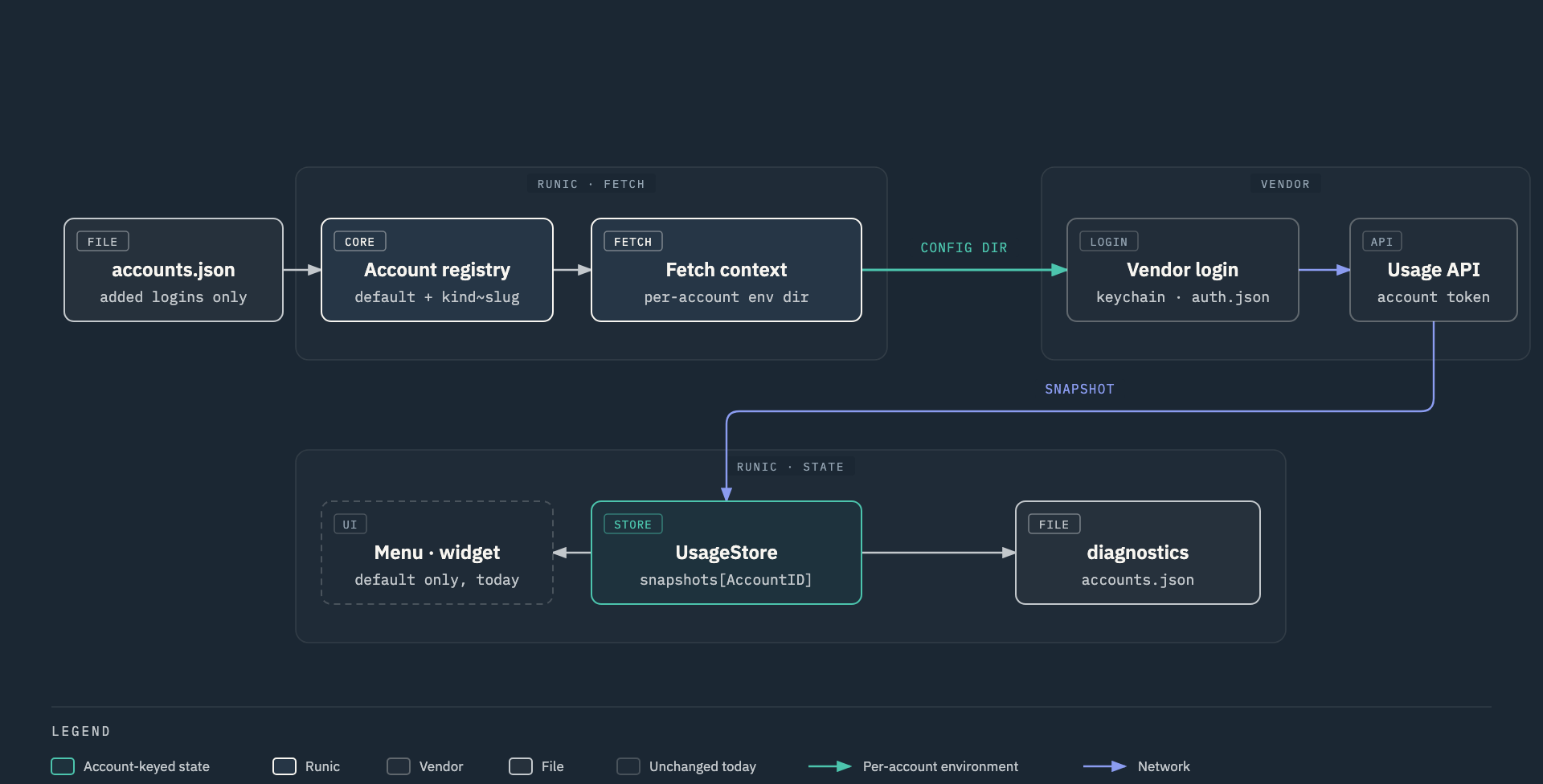
Interactive version: accounts-flow.html (follows light/dark). Design: accounts-and-windows.md.
What exists on main now
AccountIDis the key for live per-login state inUsageStore(snapshots, errors, source labels, fetch attempts, failure gates, credits, the refreshing set). The default account’s id is the provider’s raw value (claude), so nothing on disk changed for one-login installs. An added account iskind~slug(claude~work).accounts.jsonin~/Library/Application Support/Runic/lists added logins only. A missing file is the one-login world. Each entry has an id, a display name, an optional region, a credential and an enabled flag.- A refresh visits every account of a kind. The default account fetches with the process environment; an added account fetches with its credential’s location variable merged in (
CLAUDE_CONFIG_DIR,CODEX_HOME,KIMI_CODE_HOME), so the vendor’s own credential location is read for that login. - Claude reads the per-directory Keychain item Claude Code writes for a custom config dir:
Claude Code-credentials-<8 hex of sha256(dir)>(hash over the raw directory string, NFC), or<dir>/.credentials.jsonas the CLI’s fallback. Codex reads<CODEX_HOME>/auth.jsonand refreshes into the same file. diagnostics/accounts.jsonis written after every refresh: one row per account the refresh visited, with percentages, resets, source label and error. No tokens, no emails.
What does not exist yet
- No UI. The menu, widget, CLI and MCP still show the default account only.
- No Add-account sheet: the config dir and
accounts.jsonare made by hand (below). - Nobody refreshes a Claude token in a Runic-owned dir. Claude Code refreshes its token when it runs; in a dir where no CLI runs, the access token expires in hours and the account goes dark until you run
claudethere again. The scheduled probe is the next PR. - Session-quota notifications, burn samples and balance readings are recorded for the default account only.
- The Claude CLI fallback (PTY
/usage) does not take the config dir yet; an added Claude account must have a usable OAuth token. - An added account uses token-based strategies only (OAuth, API key). CLI, web-cookie and local probes read the machine’s default login, and a CLI pointed at a fresh home hangs in onboarding, so they are skipped: a missing token fails fast with
No available strategyinstead of a 45-second timeout.
Add a second Claude login by hand
-
Pick a directory for the login. Runic will own these later; any path works now.
export DIR="$HOME/Library/Application Support/Runic/accounts/claude-work" mkdir -p "$DIR" -
In the browser, switch to the Claude account you want to add first. The CLI login lands on whatever account the browser is signed into.
-
Log in into that directory. First-run prompts (theme, trust) appear because the dir is fresh; answer them.
CLAUDE_CONFIG_DIR="$DIR" claude /loginCheck the item landed under the hashed name (attributes only, no secret shown):
security find-generic-password -s "Claude Code-credentials-$(printf '%s' "$DIR" | shasum -a 256 | cut -c1-8)" | grep svce -
Register the account. The slug is yours to pick (short,
[a-z0-9]); the id isclaude~<slug>.{ "version": 1, "accounts": [ { "id": "claude~work", "displayName": "work", "credential": { "type": "oauthDir", "value": "/Users/you/Library/Application Support/Runic/accounts/claude-work" }, "isEnabled": true } ] }Save it as
~/Library/Application Support/Runic/accounts.json. Use the absolute path, the same string you exported: the Keychain name is a hash of that exact string. -
Relaunch Runic (the registry is read at launch), then Ping now. Read the diagnostics:
jq '.accounts[] | select(.kind=="claude") | {account, sourceLabel, primaryUsedPercent, secondaryUsedPercent, error}' \
  ~/Library/Application\ Support/Runic/diagnostics/accounts.json
Expected: two rows,
claudeandclaude~work, each with its own percentages andsourceLabel: "oauth". The menu still shows onlyclaude.
Add a second Codex login by hand
Same shape with CODEX_HOME:
export DIR="$HOME/Library/Application Support/Runic/accounts/codex-org"
mkdir -p "$DIR"
CODEX_HOME="$DIR" codex login      # one at a time: two Codex logins collide on the callback port
Registry entry: "id": "codex~org", "credential": { "type": "oauthDir", "value": "<that path>" }. Runic reads and refreshes <path>/auth.json. The ChatGPT-Account-Id header comes from that file, which is what makes a second workspace a second account.
If the added row shows an error
| Error text | Meaning |
|---|---|
Claude OAuth credentials not found |
No Keychain item under the hashed name and no .credentials.json in the dir. The login went into ~/.claude instead (env var not exported on the claude command), or the path string differs from the registry value. |
Claude OAuth token expired |
The token aged out and nothing refreshed it. Run CLAUDE_CONFIG_DIR="$DIR" claude once; the next refresh picks it up. |
user:profile scope missing |
The login was done with an older CLI or a Console key; redo /login with the current CLI. |
Codex auth.json exists but contains no tokens / not found |
codex login did not write into that CODEX_HOME, or the registry path differs. |
Keychain-key providers (Kimi, z.ai, …)
Not yet by hand. An added account would read <base>.<slug> (for example kimi-api-token.work) under Runic’s credential service, but an item created with the security tool carries an ACL that does not trust Runic and prompts on every read. The Add-account sheet (paste a key) writes it correctly; wait for that.
Switching a terminal to an account
Nothing in the app yet. Today:
export CLAUDE_CONFIG_DIR="$HOME/Library/Application Support/Runic/accounts/claude-work"
claude
The menu’s “Switch” action (copies that line) and runic env claude/work come with the account tabs.
Read the source ↗ Checked against Runic 2.13.5 · 9730f91